
Why Is My Cat So Active at Night? Understanding Night Behaviour
Key Takeaways
Cats are crepuscular, not nocturnal — they’re naturally wired to be most active at dawn and dusk, so nighttime energy is biology, not bad behaviour.
Common nighttime behaviours like meowing, yowling, and zoomies are usually normal, but a sudden change or intensifying pattern is worth a vet check.
Structured play earlier in the day and evening is the single most effective way to burn off the energy that would otherwise surface at 3am.
An evening treat routine can help signal “settle time” to your cat — just avoid feeding in direct response to nighttime waking, which rewards the very behaviour you’re trying to shift.
If you’ve ever been jolted awake by the sound of thundering paws across the hallway at 2am, you’re not alone. So why is my cat so active at night when the rest of the house is trying to sleep? The short, fur-real answer: it’s not naughtiness — it’s biology. Cats are crepuscular, meaning their natural activity peaks at dawn and dusk, a pattern hardwired into them by their wild ancestors’ hunting habits. The good news? While you can’t delete that instinct, a few smart tweaks to play and feeding routines can shift your cat’s schedule so it better matches yours.
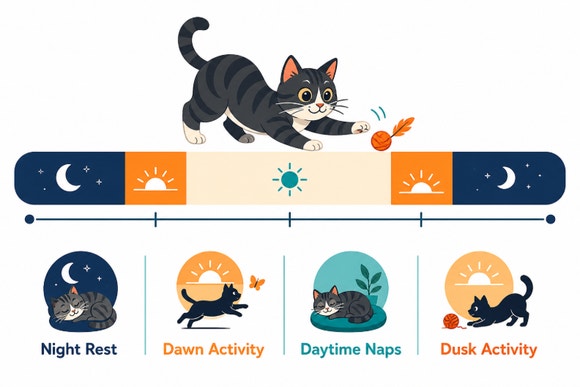
Image: A cat’s 24-hour crepuscular activity timeline, showing natural energy peaks at dawn and dusk.
Why Are Cats So Active at Night? Understanding Crepuscular Behaviour and Cat Night Vision
Here’s the thing that trips up a lot of cat parents: cats aren’t actually nocturnal. They’re crepuscular. That means their energy naturally spikes at dawn and dusk rather than in the dead of night. This rhythm comes straight from their wild ancestors, who hunted most successfully in the low light of early morning and evening, when prey was active and the cover of dim light gave them an edge.
So when you’re wondering why is my cat so active at night, the real story is that your cat’s internal clock is simply set to a different timezone. Domestic cats sleep an average of 12–16 hours a day, but that sleep is spread across multiple short naps rather than one long block — which is why a cat who napped through the afternoon may be raring to go just as you’re winding down. When the lights go out and the house goes quiet, those dawn and dusk energy peaks can blur into what feels like full-blown nighttime activity.
Understanding this matters because it changes the fix. You’re not trying to “stop” a behaviour — you’re trying to gently redirect energy that’s perfectly natural into a timeframe that suits your household better.
Common Nighttime Behaviours in Cats: Meowing, Yowling and Zoomies at Night
So what does all that crepuscular energy actually look like at 3am? Here are the behaviours owners most often describe:
Meowing and yowling: Vocalising is one of the most common nighttime complaints. If you’re asking why does my cat meow at night or why does my cat yowl at night when I go to bed, the answer is usually simple — your cat is awake, energetic, and wants attention or interaction.
Zoomies: Those sudden, full-speed laps around the house are a classic release of pent-up energy. Cat zoomies why they happen comes down to this: a cat with unspent hunting energy will find an outlet for it, and your hallway is as good a savanna as any.
Pawing and door-scratching: A cat who wants company or access to a closed-off room will let you know, often at volume.
Hunting and “gift” deliveries: Indoor cats may carry toys (or socks) around at night, acting out the hunt-catch-kill sequence their instincts demand.
These behaviours are normal in moderation. A cat who occasionally gets the zoomies or lets out a chirp at dawn is just being a cat. If you find yourself wondering why is my cat so active at night only occasionally, that’s usually nothing to worry about. The pattern to watch for is change — which brings us to the next point.
When Night Activity Might Signal a Health Issue: Do Cats Sleep at Night?
While nighttime activity is usually just your cat being gloriously, delightfully feline, a sudden change is worth paying attention to. If your cat has never been a nighttime vocaliser and suddenly starts crying at night, or if the activity is intensifying rather than settling, it’s a good idea to rule out a medical cause before assuming it’s purely behavioural.
A few health-related reasons a cat’s nighttime habits might shift include:
Cognitive decline in senior cats: Older cats can develop disorientation or altered sleep-wake cycles, sometimes called sundowning, similar to what’s seen in some older dogs and humans.
Pain or discomfort: A cat who’s uncomfortable may restlessly vocalise or move around more at night when the house is quiet.
Hyperthyroidism: Increased activity, restlessness, and vocalisation can be linked to overactive thyroid, particularly in older cats.
High blood pressure: Often associated with other conditions, this can cause restlessness and nighttime waking.
The takeaway: if you’re wondering why is my cat so active at night and the behaviour is new, escalating, or paired with other changes (appetite, weight, litter box habits), a vet visit is the sensible first step. Once health is ruled out, you can confidently move on to the behavioural strategies below.
Daytime and Evening Play: Reducing Night Energy
The single most effective way to tackle nighttime activity is to use up that energy before it has a chance to surface at 2am. Think of it like this: your cat has a daily quota of hunt-catch-kill energy. If it doesn’t get spent during the day, it gets spent on your ankles at night.
Here’s how to build a play routine that actually works:
Aim for two structured play sessions a day: One in the morning and a longer one in the evening, ideally about an hour before your own bedtime. Ten to fifteen minutes of active, chasing-style play per session is a solid target.
Use wand and chase toys: Mimic the hunt-catch-kill sequence — let your cat stalk, chase, “catch” the toy, and wind down. This full cycle is what genuinely satisfies the hunting instinct.
End with a wind-down: Follow play with a calm period and then a small feed or treat. In the wild, a cat hunts, eats, then grooms and sleeps — replicating that sequence helps signal to your cat that it’s time to settle.
Add daytime enrichment: Puzzle feeders, window perches, and rotation of toys keep your cat occupied during the day so they’re not saving all their energy for the night. For more ideas, check out our guide on how to enrich your cat’s life(open in new tab).
This is also where positive reinforcement comes in. Rewarding calm, settled behaviour with a treat reinforces the habits you want more of — our article on how to train your cat using positive reinforcement and treats(open in new tab) walks through the basics. The more you reward the behaviour you want, the more you’ll see it.
Using an Evening Treat Routine to Encourage Settling
Play gets the energy out; a treat routine helps put your cat in the mindset to rest. Adjusting when and how you feed your cat in the evening is one of the most effective ways to encourage a more settled night — but there’s one golden rule: don’t feed in direct response to nighttime waking.
Here’s why that rule matters. If your cat meows at 3am and you get up to feed them, you’ve just taught them that 3am meowing works. The behaviour gets rewarded, so it gets repeated. Instead, shift the feeding signal to a time that suits you:
Time the evening feed for just before your bedtime: A small meal or treat session right before you turn in helps your cat associate “lights out” with “full tummy and settle time.”
Use a treat as the closing act of a play session: Play hard, then offer a treat as the reward. This mirrors the natural hunt-eat-sleep cycle.
Consider an automatic feeder: For cats who wake early, a timed feeder can deliver a small breakfast before your cat decides to wake you for it. (More on this in the FAQs.)
Keep it nutritionally sound: TEMPTATIONS™ Crunchy Pockets and Creamy Spoons Treats are nutritionally complete, so an evening treat fits neatly into your cat’s daily intake without throwing things off balance.
This is where TEMPTATIONS™ Treats earn their keep — they’re an irresistible way to close out the day. A Crunchy Treat after an evening play session, or a creamy treat as a pre-bed wind-down, gives your cat something to look forward to that also signals “the day is done.” Because let’s be honest: when a treat bag rustles, even the most dignified cat loses all composure. That’s the CATS CAN’T RESIST™ magic at work.
Managing Your Cat’s Environment at Night: Helping a Cat at Night Settle
While behavioural changes take time to fully settle in, a few environmental tweaks can reduce the disruption in the meantime. Managing the space itself is a practical way to protect your sleep even while you’re working on the bigger routine shifts:
Create a dedicated night zone: If your cat’s nighttime activity is disrupting your sleep, consider setting up a comfortable space for them in another part of the house with their bed, water, and a few toys.
Block outside triggers: If your cat reacts to outdoor animals they can see or hear, close curtains or blinds and consider moving their night zone away from windows.
Use puzzle feeders and activity toys: Leave a puzzle feeder with a small amount of food so your cat has something to “hunt” if they wake before you do.
Keep the routine consistent: Cats thrive on predictability. A consistent evening sequence — play, treat, settle — helps your cat learn what comes next.
And if you’re curious about what makes your feline friend tick (and why they do the gloriously weird things they do), our 10 sassy fun cat facts for curious owners(open in new tab) is a fun read that might just explain a few nighttime quirks.
So if you’re still asking why is my cat so active at night after trying a few of these adjustments, give the routine a little time — most cats respond within a couple of weeks of consistency. Nighttime activity in cats is normal, natural, and — with the right routine — very manageable. The goal isn’t to turn your cat into a creature who sleeps eight solid hours; it’s to help them spend their energy when it suits both of you, so the only thing happening at 3am is peaceful snoozing. Ready to build a better evening routine? Explore the full range of TEMPTATIONS™ Treats(open in new tab) and find the purr-fect way to help your cat settle in for the night.