
How to Keep Indoor Cats Mentally Stimulated Every Day
Key Takeaways
Indoor cats need daily mental stimulation to satisfy their natural hunting, exploring, and foraging instincts — without it, boredom and behaviour issues can creep in.
A consistent daily enrichment routine with play, feeding puzzles, and environmental upgrades works far better than random activities.
Treats like TEMPTATIONS™ Cat Pocket treats and TEMPTATIONS™ Creamy Spoons™ can double as enrichment tools that encourage natural foraging.
Watch for signs of understimulation — excessive vocalisation, destructive behaviour, overeating, and over-grooming — and adjust the routine early.
Indoor cats live safer, cosier lives — but they miss out on the hunting, exploring, and foraging they’re hardwired to do. Without an outlet, all that pent-up instinct can bubble over into boredom, weight gain, or the kind of 3am zoomies that leave your furniture in pieces. The good news? Learning how to keep your cat mentally stimulated is easier than you think. A little daily enrichment goes a long way, and it doesn’t require turning your living room into a feline adventure playground (though your cat wouldn’t complain). Let’s dig into the purr-fect ways to keep that clever mind busy every single day.
Suggested image: A contented indoor cat watching birds from a window perch — https://images.unsplash.com/photo-1514888286974-b5977c838e72?license=free
Why Mental Stimulation Matters for Indoor Cats
Cats are born hunters. Whether they’ve ever set a paw outside or not, they still carry the same stalk-chase-pounce instincts as their wild cousins. When those instincts have nowhere to go, things get messy — and we’re not just talking about knocked-over vases. Veterinary guidance on feline environmental needs recognises that unmet instincts are a major contributor to stress and behaviour issues in indoor cats. That’s where cat enrichment comes in. It’s not a luxury; it’s daily maintenance for a healthy, happy feline mind. Think of it this way: a bored cat is a cat who’ll find their own entertainment, and you probably won’t like their choices. Cat mental stimulation isn’t about keeping your cat busy for the sake of it — it’s about giving them proper outlets for the behaviours they were born to do.
Building a Daily Cat Enrichment Routine
Here’s the thing: random enrichment doesn’t work nearly as well as a consistent routine. Cats thrive on predictability, and timing matters just as much as the activities you choose. A solid daily structure gives your cat something to look forward to and keeps their mind engaged all day long.
A good indoor cat enrichment routine might look like this:
Morning: 10–15 minutes of interactive play before breakfast
Midday: A puzzle feeder or scatter-feeding session
Evening: Another 10–15 minutes of play, followed by dinner
Overnight: Leave a treat-dispensing toy or scratching post accessible
Two play sessions a day — one in the morning, one in the evening — tap into cats’ natural dawn and dusk activity peaks. The evening session followed by food mimics the natural hunt-catch-eat cycle, which is one of the most effective ways to keep your cat mentally stimulated and reduce nighttime restlessness. Consistency beats intensity every single time.
Play-Based Cat Enrichment Ideas
Play is the most accessible form of daily enrichment there is — and it’s the one your cat is most naturally wired for. The goal is to satisfy the full stalk-chase-pounce sequence, not just wave a toy around randomly.
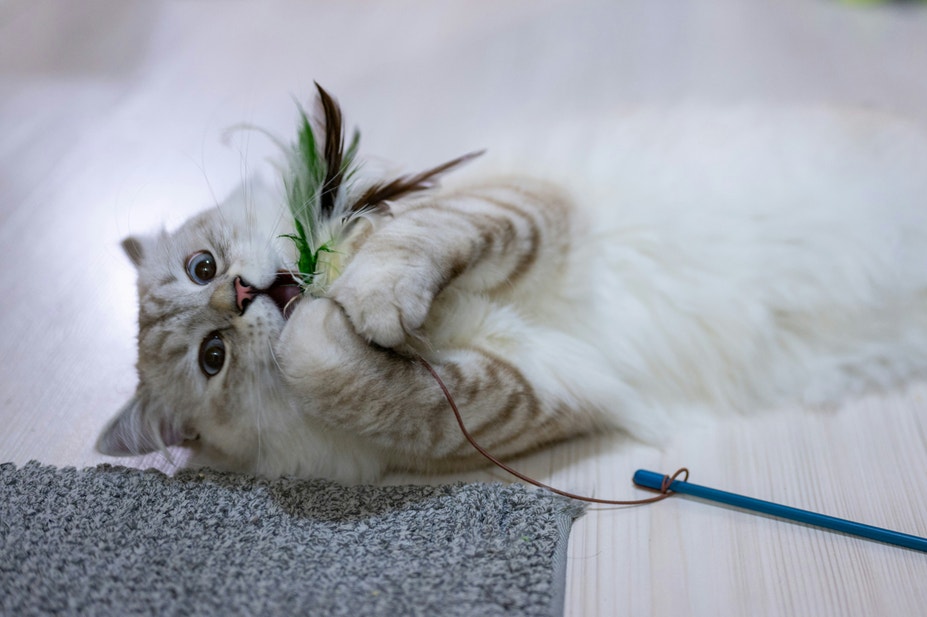
Interactive cat toys like wand toys, feather teasers, and laser pointers get your cat moving and thinking. Move the toy like prey — darting, hiding, pausing — so your cat can stalk and plan before the pounce. That planning is where the real mental workout happens.
Cat hunting instinct play doesn’t have to be complicated. Try these simple ideas:
Rotate toys weekly so novelty stays high
Use puzzle toys that dispense treats when solved
Try clicker training for 3–5 minutes a day — yes, cats can learn tricks!
Set up a “treasure hunt” by hiding small toys or treats around a room
Short, frequent sessions work better than one long marathon. Cats are sprinters, not endurance athletes — 10 to 15 minutes of focused play is plenty. If you want to know how to keep your cat mentally stimulated without spending a fortune, rotating a small toy collection is one of the easiest cat enrichment ideas there is.
Using Treats for Feeding-Based Enrichment
Treats aren’t just for spoiling your cat (though we fully support that too). They’re one of the best tools for feeding-based enrichment — encouraging natural foraging behaviour instead of simply handing over a snack. When you make your cat work for a treat, you’re turning a 30-second snack into a 10-minute problem-solving session.
Puzzle feeders, treat-dispensing balls, and snuffle mats all force your cat to think, paw, and problem-solve before they get their reward. You can even go DIY: fold treats into a paper towel tube with the ends pinched, or hide small portions in an egg carton filled with crumpled paper.
This is where TEMPTATIONS™ treats shine. TEMPTATIONS™ Cat Pocket treats are paw-some for stuffing into puzzle toys — their crunchy outside and soft centre make them worth working for. Or try TEMPTATIONS™ Creamy Spoons™ treats, the creamy spoon cat treat that turns lick-mat enrichment into a genuinely exciting event. Just spread the creamy treat across a lick mat and let your cat work for every delicious bit. Cat creamy treats like these are purr-fect for slow feeding and mental engagement. You can even use Creamy Spoons cat food as a meal complement to make regular mealtime extra special.
Want to take it further? Hide a few Cat Pocket treats around the room and let your cat “hunt” for them — it’s one of the simplest indoor cat enrichment ideas, and it taps straight into that foraging instinct. After all, if you’re wondering how to keep your cat mentally stimulated, making mealtime an adventure is a cracking place to start.
Environmental Enrichment: Vertical Space, Hiding Spots, and Scratching
Your cat’s surroundings play a constant, passive role in their daily mental stimulation — even when you’re not actively playing with them. A well-set-up environment keeps your cat’s brain engaged all day, every day.
Vertical space for cats is a game-changer. Cat trees, wall-mounted shelves, and window perches give your cat a safe vantage point to observe their kingdom from above. A cat who can climb to watch the world go by is measurably calmer than one stuck at floor level. If you can place a cat tree near a window — ideally one with a view of trees, birds, or a bird feeder — you’ve just created passive cat enrichment at home that works while you’re at work.
Don’t forget hiding spots and scratching. Cats need safe, enclosed spaces to retreat to — cardboard boxes, covered beds, or even a paper bag with the handles removed. Scratching posts (especially tall sisal ones) let your cat stretch, mark territory, and keep their claws in top shape. Rotate hiding spots and scratchers every so often to keep things fresh.
When it comes to how to keep your cat mentally stimulated, the environment does a lot of the heavy lifting. Get the setup right and you’re winning most of the battle.
Signs Your Cat Needs More Mental Stimulation
Sometimes the clearest sign that your cat needs more enrichment comes from their behaviour. Recognising under-stimulation early makes it far easier to adjust the routine before it snowballs into a bigger issue. Keep an eye out for these tell-tale signs:
Excessive vocalisation: If your cat has ramped up the meowing or yowling — especially at odd hours — they may be asking for more engagement.
Destructive behaviour: Scratching furniture, knocking things over, or treating your curtains like a climbing wall can signal pent-up energy.
Overeating or weight gain: Boredom-driven eating is a recognised contributor to unwanted weight gain in indoor cats.
Over-grooming: Excessive licking or grooming to the point of hair loss can be a stress response linked to under-stimulation — though it’s worth ruling out medical causes with your vet first.
If you spot any of these, it’s a sign to dial up the daily enrichment. More play, more puzzle feeding, more environmental variety. Learning how to keep your cat mentally stimulated is an ongoing process — your cat’s needs will change over time, and the best routine is one that flexes with them.
Ready to make enrichment time the best part of your cat’s day? Stock up on TEMPTATIONS™ Cat Pocket treats(open in new tab) and TEMPTATIONS™ Creamy Spoons™(open in new tab) — the irresistible rewards that make every puzzle, hunt, and lick-mat session worth the effort. For more ideas on using treats to build a stronger bond with your cat, check out our guide on how to train your cat using positive reinforcement and treats(open in new tab). Explore the full range of TEMPTATIONS™ treats and discover more ways to spoil your cat at temptationstreats.com.au(open in new tab).
Daytime and Evening Play: Reducing Night Energy
The single most effective way to tackle nighttime activity is to use up that energy before it has a chance to surface at 2am. Think of it like this: your cat has a daily quota of hunt-catch-kill energy. If it doesn’t get spent during the day, it gets spent on your ankles at night.
Here’s how to build a play routine that actually works:
Aim for two structured play sessions a day: One in the morning and a longer one in the evening, ideally about an hour before your own bedtime. Ten to fifteen minutes of active, chasing-style play per session is a solid target.
Use wand and chase toys: Mimic the hunt-catch-kill sequence — let your cat stalk, chase, “catch” the toy, and wind down. This full cycle is what genuinely satisfies the hunting instinct.
End with a wind-down: Follow play with a calm period and then a small feed or treat. In the wild, a cat hunts, eats, then grooms and sleeps — replicating that sequence helps signal to your cat that it’s time to settle.
Add daytime enrichment: Puzzle feeders, window perches, and rotation of toys keep your cat occupied during the day so they’re not saving all their energy for the night. For more ideas, check out our guide on how to enrich your cat’s life(open in new tab).
This is also where positive reinforcement comes in. Rewarding calm, settled behaviour with a treat reinforces the habits you want more of — our article on how to train your cat using positive reinforcement and treats(open in new tab) walks through the basics. The more you reward the behaviour you want, the more you’ll see it.
Using an Evening Treat Routine to Encourage Settling
Play gets the energy out; a treat routine helps put your cat in the mindset to rest. Adjusting when and how you feed your cat in the evening is one of the most effective ways to encourage a more settled night — but there’s one golden rule: don’t feed in direct response to nighttime waking.
Here’s why that rule matters. If your cat meows at 3am and you get up to feed them, you’ve just taught them that 3am meowing works. The behaviour gets rewarded, so it gets repeated. Instead, shift the feeding signal to a time that suits you:
Time the evening feed for just before your bedtime: A small meal or treat session right before you turn in helps your cat associate “lights out” with “full tummy and settle time.”
Use a treat as the closing act of a play session: Play hard, then offer a treat as the reward. This mirrors the natural hunt-eat-sleep cycle.
Consider an automatic feeder: For cats who wake early, a timed feeder can deliver a small breakfast before your cat decides to wake you for it. (More on this in the FAQs.)
Keep it nutritionally sound: TEMPTATIONS™ Crunchy Pockets and Creamy Spoons Treats are nutritionally complete, so an evening treat fits neatly into your cat’s daily intake without throwing things off balance.
This is where TEMPTATIONS™ Treats earn their keep — they’re an irresistible way to close out the day. A Crunchy Treat after an evening play session, or a creamy treat as a pre-bed wind-down, gives your cat something to look forward to that also signals “the day is done.” Because let’s be honest: when a treat bag rustles, even the most dignified cat loses all composure. That’s the CATS CAN’T RESIST™ magic at work.
Managing Your Cat’s Environment at Night: Helping a Cat at Night Settle
While behavioural changes take time to fully settle in, a few environmental tweaks can reduce the disruption in the meantime. Managing the space itself is a practical way to protect your sleep even while you’re working on the bigger routine shifts:
Create a dedicated night zone: If your cat’s nighttime activity is disrupting your sleep, consider setting up a comfortable space for them in another part of the house with their bed, water, and a few toys.
Block outside triggers: If your cat reacts to outdoor animals they can see or hear, close curtains or blinds and consider moving their night zone away from windows.
Use puzzle feeders and activity toys: Leave a puzzle feeder with a small amount of food so your cat has something to “hunt” if they wake before you do.
Keep the routine consistent: Cats thrive on predictability. A consistent evening sequence — play, treat, settle — helps your cat learn what comes next.
And if you’re curious about what makes your feline friend tick (and why they do the gloriously weird things they do), our 10 sassy fun cat facts for curious owners(open in new tab) is a fun read that might just explain a few nighttime quirks.
So if you’re still asking why is my cat so active at night after trying a few of these adjustments, give the routine a little time — most cats respond within a couple of weeks of consistency. Nighttime activity in cats is normal, natural, and — with the right routine — very manageable. The goal isn’t to turn your cat into a creature who sleeps eight solid hours; it’s to help them spend their energy when it suits both of you, so the only thing happening at 3am is peaceful snoozing. Ready to build a better evening routine? Explore the full range of TEMPTATIONS™ Treats(open in new tab) and find the purr-fect way to help your cat settle in for the night.
Frequently Asked Questions
It can help. Many issues - litter box avoidance, excessive vocalisation, scratching - link to stress and under-stimulation. Daily enrichment gives cats proper outlets. If issues persist, consult your vet to rule out medical causes